
Godrej Food Trends Report 2026: Sourish Bhattacharya on Tracing the Roots of What We Eat
A candid conversation from the the launch of the latest edition of the Godrej Food Trends Report on how narrative and genuine storytelling have the potential to transform Indian restaurant menus for the better
11 May 2026
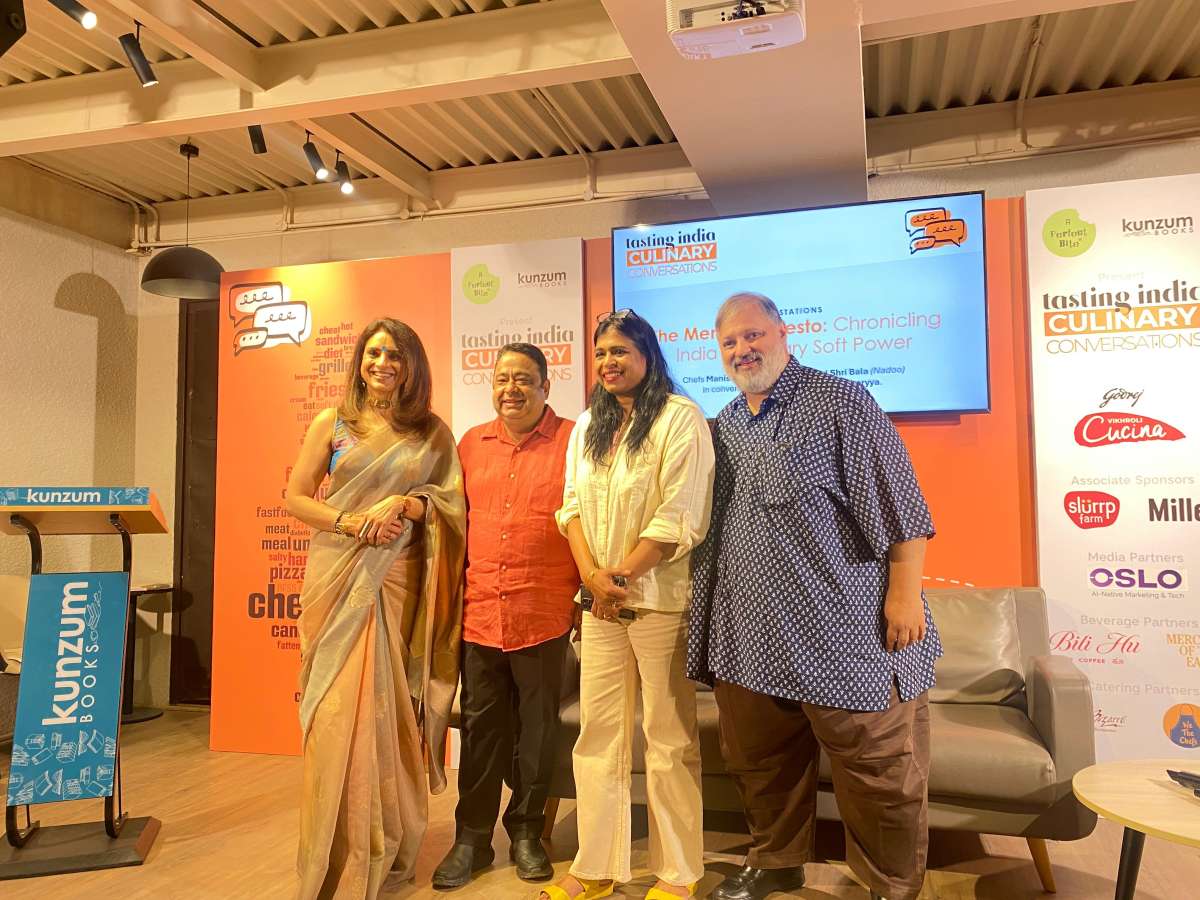
On the sidelines of the Godrej Food Trends Report (GFTR) launch at Kunzum Books, Greater Kailash, New Delhi, we caught up with veteran journalist Sourish Bhattacharyya and got into the details of what is really missing in India’s food scene right now: a good story (which also happens to be the theme of this year’s report.)
Mr. Bhattacharyya explains how tracing an ingredient's roots, and acknowledging the regional producers behind it, completely changes the experience on the plate. It is a shift that turns eating from just an everyday routine into a conscious, emotional connection.
Sourish Bhattacharyya: Hi I'm Sourish Bhattacharyya. Journalist, Co-Editor of The Bloomsbury Handbook of Indian Cuisine and Co-Curator of this event, Tasting India: Culinary Conversations.
Dhruv Nimbalkar: Hello, Mr. Bhattacharyya, I'm Dhruv, from team Vikhroli Cucina! So, what do you make of the Godrej Food Trends report? Given that we've been having an edition year on year…
Sourish Bhattacharyya: I've been following the GFTR, as we call it, from the first report, and I feel that they're all very well organised with their presentation of trends, they're so with the times—and also ahead of the times! It's also, I believe, the only food trends report of its kind that we have in our country! One of the issues I always have is that restaurants and the food industry often function in the dark; they often don't know what people want. Here is the kind of useful information they need. The Report distills the views and impressions and experiences of people and brings them together in one easy digestible form.
Dhruv Nimbalkar: We could say that it gives restaurants and people in this space a guide of sorts that helps them understand what the consumers want…
Sourish Bhattacharyya: Right, and it has taken inputs from both consumers as well as specialists. So it's a very happy combination.
Dhruv Nimbalkar: Let's get into a few questions… Media is currently saturated with fleeting digital micros, or what we call fads, as mentioned earlier. Which regional culinary narrative, according to you, actually deserves sustained, long-term focus?
Sourish Bhattacharyya: You know, I think all our regional culinary narratives need to be amplified, and while I think that is already being done, thanks to both digital creators and traditional news writers, I also believe that the way forward is to also dive deeper into caste- and region-based cuisines.
Yesterday, Anushruti R.K. was talking about her book, The Sattvic Wave, and she comes from this Brahmin community in Uttara Kannada district of Karnataka. Those are the kinds of micro-regional specificities we have to now start capturing. Work needs to be done on spotlighting Dalit and tribal cuisines and communities too. I was doing some work on Jharkhand’s cuisine, and I was told that they have thirty-six tribes in the state, but the cuisines of only about a dozen-or-so have been documented!
Dhruv Nimbalkar: You're saying that it's time that some of the lesser-known Subaltern narratives should come forward!
Sourish Bhattacharyya: Yes, you know, when we were students of history, there was a branch of history which was developed called Subaltern Studies, which went into how a certain historic figure of importance, say, Gandhi, was viewed, say, in the district of Gorakhpur, UP, in the year 1931 or something like that. It was very instructive to see a national figure through the lens of a local community. Likewise, we need to see food from that sort of perspective. Is the food of Gorakhpur different from the food of Varanasi, which is different from the food of Meerut? Only then will a lot of interesting local specificities begin to come out.
Dhruv Nimbalkar: We take one prominent food of a region and then we see how it differs across regions?
Sourish Bhattacharyya: Yes, now for instance we say, "Indian food is spicy." No, that's just such a vast generalisation. Or you know, that "Indian food has too many chilies in it." It's so different from reality. We know that, but that information now needs to be documented. What Rushina and Godrej have been doing with the report is already a big step in that direction, and I anticipate they will start looking even more closely into the micro-regional components of our national cuisine.
Dhruv Nimbalkar: Do you think that subaltern recipes and ways of cooking will find a place to stay in the mainstream?
Sourish Bhattacharyya: Yes, absolutely. I remember when I was studying about Jharkhand cuisine, one of my favourites that stood out was the red ant chutney. I had heard only about the red ant chutney in Chhattisgarh because Gordon Ramsay had made it popular. I'm sure a lot of discoveries like these need to be made, but I have to say that one lifetime is not enough for it. I'm the co-editor of a book called The Bloomsbury Handbook of Indian Cuisine. Now, when I read about the different cuisines, and their micro-regional variants, I think that we can write five volumes of the book, and still have ground to cover. So, my dream is to come up with a multi-cultural, multi-volume encyclopedia of Indian cuisine!
Dhruv Nimbalkar: Absolutely, it will be a very large repository. Do you think it's become easier enough for us to document some of these less-heard-of stories and recipes with social media?
Sourish Bhattacharyya: I feel, unfortunately, that the advent of social media, especially Instagram, has done some injustice to it. I'll tell you why, for instance, the way street food is "sexified"— we move away from the essence. We just focus on the drama of the street food, but not the people behind this street food. Who are the people, who are the producers of street food? So, the entire focus has shifted to consumption, whereas I think we should also look at the producers of food. And by producers of food, I also mean the farmers. We have to go back to the farmers, the dairy producers, the orchard farmers, people who are producing raw materials, which make our food culture so diverse. Once we go into that, then I think our story will be complete. And there is work happening, where people are going to the farms and trying to see how things are done, but it shouldn't be a fad, the way coffee is, an increasingly urban thing to do. There's just a lot more to discover.
Dhruv Nimbalkar: The theme of this year's report is storytelling, and it sort of ties into this aspect of going across these touchpoints to who is really bringing this food to you. In your experience, how do you think that covering these touchpoints enhances a meal, at the end of the day for the consumer?
Sourish Bhattacharyya: Right, internationally, it's an accepted fact—and this started as a movement in California back in the 1970s—that once people know that, "Oh, this farmer produced this, and I'm having that food," that gives us a sense of joy, a sense of relating to the food. Otherwise, what is a restaurant or a hotel? It's an industrial enterprise. People are working on an assembly line and bringing you food. But once you know that the food has come from a particular place in a particular way, then there is excitement, there is storytelling around food.
That, unfortunately, hasn't been happening in a big way in our country yet. I've seen it in America, I've seen it in the Nordic countries, in Italy, in France. There's a lot of storytelling around food, which should happen now, I think, in our country. Interestingly, the mixologists are talking a lot about herbs and spices. They are sourced from different parts of the country, and they are foraging for those ingredients. And when they talk about foraging, it creates excitement about the ingredients and also about the cocktails.
Dhruv Nimbalkar: You've documented the evolution of restaurant menus for decades now. How are you seeing this sort of algorithm-driven content changing the way chefs are looking at menus?
Sourish Bhattacharyya: I think that if we just start looking at menus only based on algorithms—which they sometimes have to, because ultimately the restaurant business is a business and it is all about making money—that will be a sad thing to happen to cuisine, I think. But it's a Catch-22 situation. You need Instagram visibility, all social media is a means to visibility, to become known. And now, increasingly, chefs are not happy just by being known in the neighbourhood; they want to be known all over the country. They want their venture capitalists, future investors to know about them and to be confident about their business. That can only happen if there is a lot of social media buzz around them, which is why I think chefs are increasingly trying to become celebrities. But I don't blame chefs, because it is a commercial enterprise. I mean, we cannot say, "Oh, no, I will not follow the market trends." But perhaps here is a space where we can actually bring some of these stories. Actually, I was thinking ... Instead of following a trend, why don't you create a trend? And I think we'll create a trend by introducing the storytelling element, which not many chefs or mixologists are doing now.
But even looking at Mithai, there's so much storytelling around Mithai, which we just don't talk about. The other day someone said, "So which is the best cheesecake you've had?" And when I said Chhenapoda of Odisha, they thought I'd say New York cheesecake or something like that! But I think we have the best cheesecake in our own country, and let's go and celebrate it and talk about it. Talk about the makers of Chhenapoda—when Chhenapoda is served in a restaurant, let's talk about the district it has come from. For how long is it being made? How is it different from the New York cheesecake? Then you create some excitement about everything you make.
Dhruv Nimbalkar: In your experience, what has been a story of either an ingredient or a dish that has really stayed with you, that has really caught your attention, and that you think is a benchmark of storytelling?
Sourish Bhattacharyya: Alice Waters, for instance, pioneered the locavore revolution—cooking with whatever is growing within a walkable radius. In fact, Alice Waters came to India back in 2017, and of all the places she went, she had a meal at Shree Thaker Bhojanalaya in Kalbadevi, where she ordered the jowar bhakri.
She went there because she was getting food where real provenance was talked about. For instance, a long time back, on the invitation of a wine company, I had gone to Baramati. There was a chef, and because we used to begin with a champagne breakfast and used to have wine from eight in the morning till one at night... I once asked him, "You're famous for Puneri cuisine. Why can't you do a Puneri breakfast for us? Why are you doing this fancy Western breakfast just because you're serving sparkling wine?" Then all the journalists said, "Yes, yes, we want a Puneri breakfast," and he did it! Then he talked about Puneri food, about Kolhapur, Nagpur ... all the different kinds of food that are cooked and eaten in Maharashtra, and why historically they are different. If you look broadly at Maharashtra—which you know better than I do—Konkan, Vidarbha, Marathwada ... you're talking about three distinctly different culinary regions. Within Konkan, there's so much difference between the north and the south, and as you go deeper south, Goa is different, and so is Karwar. When there's so much diversity, I think we should capture that.
Talking about storytelling, there's a place called Carnatic Cafe, very near where we are sitting. They serve the Malleshwaram 18th Cross Dosa. This is a big dosa; one person cannot finish it alone, so two or three people have to eat it together. Look, the founder of Carnatic Cafe created a story out of nothing! Malleshwaram is an old neighbourhood of Bangalore, famous for people like the late Nobel laureate C.V. Raman and Prakash and Deepika Padukone. The dosa has been inspired by what the creator of Carnatic Cafe remembers eating at one of the local stalls when he was growing up. The moment you talk about that, you feel connected to a story of a certain place. And these are much deeper, rooted stories than what is on Instagram.
Dhruv Nimbalkar: What shift do you foresee in consumption, just the way we consume food, once awakened to this kind of storytelling?
Sourish Bhattacharyya: Once you're awakened to storytelling, food isn't just a physical need ... it becomes an emotional need. Food becomes a way of connecting with the world and discovering new experiences. It's not just you going out to eat something new, or ordering from one of the aggregators. That is not what food is going to be if storytelling comes to the center. I think very soon the aggregators will have to start storytelling. They will have to do curated meals. I'm sure the aggregators will get the biggest restaurants and curators and draw them into the fold.
But that's why I feel Godrej, being a major industrial enterprise, one of the largest companies of the country, and which is so heavily invested in food, can set a trend by making storytelling a national movement. Each of our dishes has a story behind it. And I think if we capture those stories, we can get people hooked.
Dhruv Nimbalkar: I also foresee an anti-dramatic effect, where we would finally move towards conscious consumption.
Sourish Bhattacharyya: Actually, yeah. Drama is on Instagram. Conscious consumption happens on the table.
Dhruv Nimbalkar: On the table, you know, where we're less wasteful of resources. We're more mindful of where that food is coming from.
Sourish Bhattacharyya: You used two very important words: less wasteful and mindful. Mindful eating and mindful drinking have become very big. And talking about trends, I see them becoming big trends in India as well. Yesterday there was a lot of talk about this purple yam becoming the new matcha, and people were talking about it as a new thing. But purple yam has been grown in India for ages, it's a part of our diet! If you come from Mumbai, you know about Undhiyu. You can't have Undhiyu without it.
Dhruv Nimbalkar: Any closing statements, Mr Bhattacharyya? When you look into the future of the food industry, what do you foresee?
Sourish Bhattacharyya: I believe that Indian food culture has moved from the Culinary Stone Age—which was when I was a young boy growing up in Delhi, where we had something called "Continental food" or "Mughlai food". We were given a choice: "What do you want? Mughlai, South Indian, or Indian?" And it turned out that Indian meant North Indian! So it used to be Mughlai, South Indian, and Indian! And then Chinese—Punjabi Chinese.
That was how it was in the 1970s or 80s. The 1970s was the first time I had Chinese food. The most sought-after dish used to be American Chop Suey.
Dhruv Nimbalkar: We still have that, one of my favorite dishes!
Sourish Bhattacharyya: So today, when we talk about Chinese, we talk about Hunanese cuisine, Xinjiang... Xinjiang is actually bordering Kashmir, and they are famous for their kebabs. So they also have Chinese kebabs! Xinjiang is a very important part of Chinese culinary history, but obviously, they don't talk much about it for political reasons, the same reason they don't talk much about Tibetan food. But sitting in Delhi, we get to eat everything. Today we have moved from what I call the Culinary Stone Age to Age of Discovery!
Dhruv Nimbalkar: I think there will be more granular precision in knowing where your food comes from and what it stands for. Do you see that happening maybe?
Sourish Bhattacharyya: That will definitely happen, that is the next step forward.
Dhruv Nimbalkar: And I think this report will clearly drive home this point, make it a national movement.
Sourish Bhattacharyya: Absolutely. So storytelling has to be it. Between now and the 10th report, storytelling should be the buzzword!
Ultimately, as India’s culinary landscape matures past the era of generalised menus, the path forward is clear. The next big trend is the story behind the plate! If the industry can successfully pivot from fleeting social media trends to rooted, regional storytelling, we might just see a genuine culture of conscious consumption take hold!
Rate this story:
Tags
Godrej Food Trend Report
Sourish Bhattacharyya
Delhi food scene
0 Comment
You may also like
-
People Malaika Arora’s Sweeney Bombay is redefining the idea of comfort food
by Vikhroli Cucina
-
People A Table chez Anou, Geneva’s Only Plant-Based Chef's Table
by Vikhroli Cucina -
People The air fryer effect on Indian home cooking
by Vikhroli Cucina -
People Chef Vanika Choudhary: Cooking with memory, land and time
by Vikhroli Cucina