3 - From royal kitchens to temple offerings, the stories behind India's Diwali foods
Take a journey across India to discover the fascinating histories, cultural traditions and unexpected stories behind its festive favourites.
06 Nov 2026
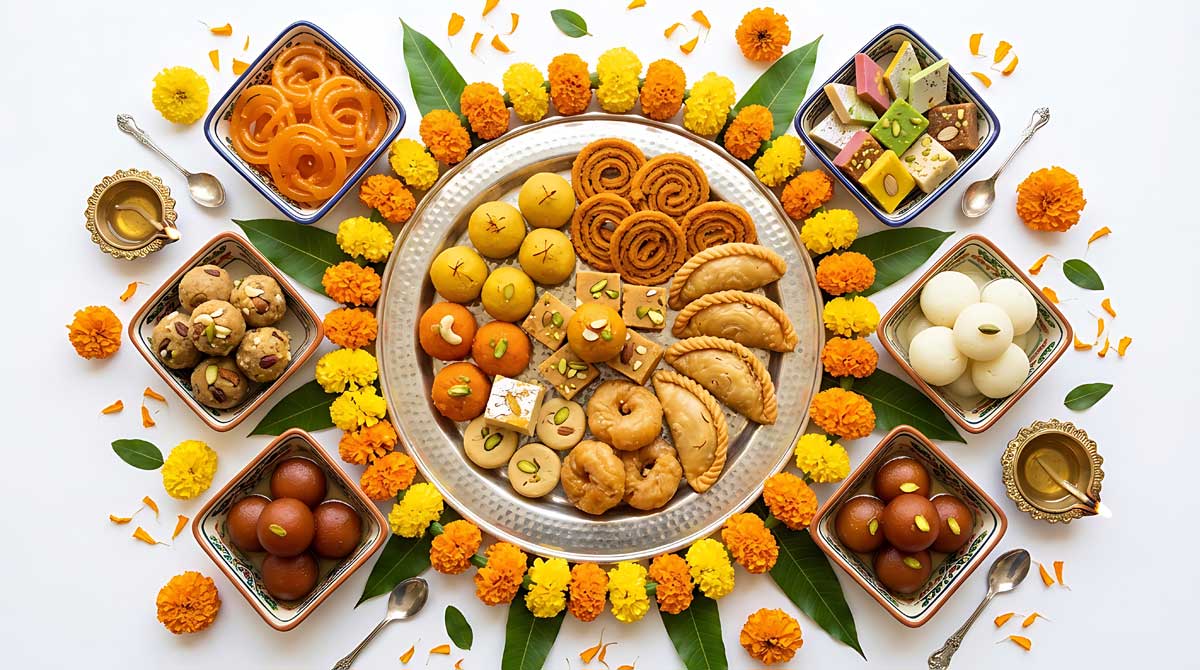
There's a particular kind of excitement that takes over Indian kitchens as Diwali approaches. The grocery lists get longer, the frying begins, containers mysteriously empty before the snacks have even cooled down, and every household seems to have its own version of what belongs on the festive table.
But have you ever wondered how these foods became part of Diwali in the first place? Some have connections to royal kitchens and temple offerings, while others reflect agricultural practices, regional ingredients and traditions that have been passed down through generations.
In fact, the history of Diwali food is just as varied as the way the festival is celebrated across India. A sweet that appears in a centuries-old inscription, a royal creation that eventually found its way into neighbourhood sweet shops, and a humble rice preparation that became the centrepiece of an entire festive breakfast all have a place in this story.
So, let's look beyond the familiar festive spread and explore the histories behind some of India's much-loved Diwali foods.
Karanji: The medieval beginnings of a festive favourite
Region: Maharashtra
Few things announce Diwali in a Maharashtrian household quite like a freshly fried Karanji. With its crisp, flaky exterior and sweet coconut or dry-fruit filling, this crescent-shaped delicacy has earned its place among the most recognisable items of Diwali faral. Its history, however, is believed to go back much further.
An early reference to Gujiya, a close relative of Karanji, dates back to the 13th century in the Bundelkhand and Braj regions. Historical food accounts describe a preparation in which a mixture of jaggery and honey was wrapped in wheat flour and sun-dried. It was considerably different from the fried, stuffed pastry we know today, but it offers an interesting glimpse into the evolution of India's sweet preparations. Over the centuries, the preparation developed regional identities. Maharashtra came to know it as Karanji, Gujarat as Ghughra and Karnataka as Karjikayi. In North India, Gujiya became a popular festive sweet, with fillings that often included khoya and dried fruits. The modern versions may differ in their ingredients and preparation, but they share the idea of enclosing a sweet filling inside a pastry shell.
What makes it interesting: Karanji is an example of how a food preparation can travel across regions, evolve with local ingredients and eventually become part of different festive traditions.
Mysore Pak: The sweet that came out of a royal kitchen
Region: Karnataka
Not every famous sweet begins with a carefully planned recipe. Sometimes, all it takes is a royal kitchen, a curious cook and a little experimentation. Mysore Pak is believed to have originated in the kitchens of the Mysore Palace during the reign of Maharaja Krishna Raja Wadiyar IV, who ruled from 1902 to 1940. The story centres on Kakasura Madappa, the palace's royal cook. While experimenting with gram flour, ghee and sugar, he reportedly created a rich, melt-in-the-mouth sweet that caught the king's attention. The Maharaja enjoyed it so much that Madappa was encouraged to make it available to the public by setting up a shop outside the palace.
The name has an interesting connection too. The Kannada word paka refers to a sweet preparation or sugar syrup, which is an essential part of making the delicacy. What began as a palace creation eventually became one of Karnataka's most recognisable sweets. Today, Mysore Pak is a familiar presence at weddings, celebrations and festive gatherings across South India. And while it isn't a sweet invented specifically for Diwali, its journey from royal kitchens to festive tables makes it an interesting addition to India's larger celebration of sweets.
What makes it interesting: A sweet that started as an experiment in a royal kitchen eventually became accessible to everyone. Not a bad outcome for a combination of three ingredients!
Adhirasam: A temple offering that made it into a 16th-century inscription
Region: Tamil Nadu
If you thought Adhirasam was simply another traditional Deepavali sweet, its historical connection might surprise you. Made with rice flour and jaggery, this deep-fried delicacy has a long association with Tamil Nadu's religious and festive food traditions. Food historian K. T. Achaya traces similar preparations to the Chola period, while accounts of South Indian culinary traditions also associate it with the Vijayanagara era. But one particular historical reference makes its connection with Deepavali especially fascinating.
A 1542 inscription at the Tirumala Venkateswara Temple in Tirupati reportedly records an offering of two Adhirasams to the deity on Deepavali. The inscription includes the words Deepavali naal adhirasam padi erandu, referring to two Adhirasams being offered on the festival. The discovery was highlighted by archaeologist and historical researcher Kudavayil Balasubramanian, who studied the inscription and its significance in understanding historical Deepavali celebrations in South India. Its culinary relatives include Kajjaya in Karnataka and Ariselu in Andhra Pradesh, which also use rice flour and jaggery as their primary ingredients.
Anarsa: A rice-based sweet with regional roots
Region: Maharashtra and Bihar
Anarsa is one of those traditional sweets that reminds us how closely Indian festive food is connected to locally available ingredients. Made using rice and jaggery or sugar, Anarsa is particularly popular in Maharashtra and Bihar. Its preparation requires a little patience. Rice is soaked, dried and ground before being combined with the sweetener to form a dough. The mixture is shaped into discs, often coated with poppy seeds, and fried until crisp on the outside.
The sweet also has regional counterparts. Andhra Pradesh has Ariselu, while Chhattisgarh has Araase. Although their preparations and textures differ, they share a similar combination of rice and traditional sweeteners. But Anarsa's interesting story isn't just about its ingredients. Its place in Maharashtra's Diwali faral tradition is documented in historical accounts of festive food.
Food historian Chinmay Damle's research into Pune's Diwali celebrations records Anarase among the traditional foods served during Diwali gatherings in the 1930s. It was part of a much larger spread that included Chakli, Chivda, Shev, Karanji and Laddoos. This gives us a lovely glimpse into how established the tradition of preparing and sharing homemade faral had become in Maharashtra nearly a century ago.
Fov: Why Goan Diwali begins with flattened rice
Region: Goa
In Goa, Diwali celebrations come with a breakfast tradition that deserves just as much attention as the sweets and savouries found elsewhere.
Fov, or flattened rice, is an essential part of the festive morning in many Goan Hindu households. Prepared in several sweet and savoury variations, it takes centre stage after the morning prayers.
But there's a lovely story behind why this humble ingredient holds such importance.
The tradition is connected to the story of Krishna and his childhood friend Sudama. According to the popular tale, Sudama visited Krishna carrying a humble offering of poha. Despite having very little, he brought what he could afford, and Krishna welcomed the offering with affection.
Goan food traditions connect this story with Krishna's victory over Narakasura. When Krishna returned victorious, people are said to have prepared poha to celebrate, making it part of the festival's food customs.
The celebration has developed its own delicious variations. Batat Fov combines flattened rice with potato, coconut and green chillies, while Rosantlem Fov is a sweet preparation made using coconut milk and jaggery. Other versions include combinations with buttermilk, curd, kokum and fresh coconut.
There's also a connection to Goa's agricultural calendar. Diwali falls around the post-monsoon harvest period, when newly harvested rice becomes readily available. Flattened rice, therefore, has both a cultural and an agricultural place in the celebration.
Food traditions have a way of surviving even as everything around them changes. Recipes get passed down, ingredients get adapted and every generation seems to have its own little disagreement over how a particular dish should taste. Perhaps that's why some festive foods are so difficult to replace. They aren't just things we look forward to eating. They carry memories, family habits and stories that have been around much longer than we have.
Which one of these is your go-to Diwali favourite? Let us know in the comments!
Rate this story:
Tags
Indian festivals
Diwali
Regional Indian Cuisine
Festive Foods
Indian food history
traditional Indian sweets
Diwali food traditions